Why Sausage Packaging Demands High-Barrier Films
Sausages are sensitive to oxygen, moisture, and light. Exposure to oxygen accelerates lipid oxidation, causing rancidity, color fading, and flavor loss. Moisture migration leads to sogginess or dryness, while light can degrade pigments and vitamins. For processors and retailers in Vietnam, Indonesia, and Thailand, maintaining product quality from factory to shelf is critical—especially in tropical climates where heat and humidity stress packaging performance.
High-barrier films are essential to protect sausages during storage, transport, and retail display. Among barrier materials, EVOH (ethylene vinyl alcohol) copolymer stands out for its exceptional oxygen barrier, particularly in high-humidity conditions where other barriers like nylon or PET may falter.
What Makes EVOH Film Ideal for Sausages?
EVOH is a copolymer of ethylene and vinyl alcohol. Its molecular structure creates a tortuous path for gas molecules, resulting in oxygen transmission rates (OTR) that are significantly lower than common plastics. When sandwiched between moisture-resistant layers like polyethylene (PE) or polypropylene (PP), EVOH retains its barrier properties even in humid environments.
Key benefits for sausage packaging include:
- Superior oxygen barrier: Helps prevent oxidation, extending shelf life without refrigeration in some cases.
- Aroma and flavor preservation: Locks in smoky, spicy, or cured notes while blocking external odors.
- Moisture retention: Reduces weight loss and maintains texture.
- Thermal stability: Withstands retort, pasteurization, and hot-fill processes.
- Compatibility: Coextruded or laminated with PE, PP, and tie layers for strong seals and puncture resistance.
Typical EVOH Structures for Sausage Packaging
EVOH is rarely used alone due to moisture sensitivity. Instead, it is embedded in multilayer structures. Common configurations include:
- PE/EVOH/PE: For chilled or frozen sausages; provides excellent moisture barrier and sealability.
- PA/EVOH/PE: Nylon adds puncture resistance and thermoformability, ideal for vacuum packs.
- PP/EVOH/PP: For retort applications; withstands high temperatures.
- PET/EVOH/PE: For sliced or snack sausages; offers stiffness and printability.
Film thickness typically ranges from 50 to 150 microns, with EVOH layer contributing 5–20% of total thickness. The EVOH grade (e.g., 32 mol% ethylene) influences barrier and processing; higher ethylene content improves moisture resistance but slightly lowers oxygen barrier.
Application Guidance: Matching Film to Sausage Type
Fresh Sausages
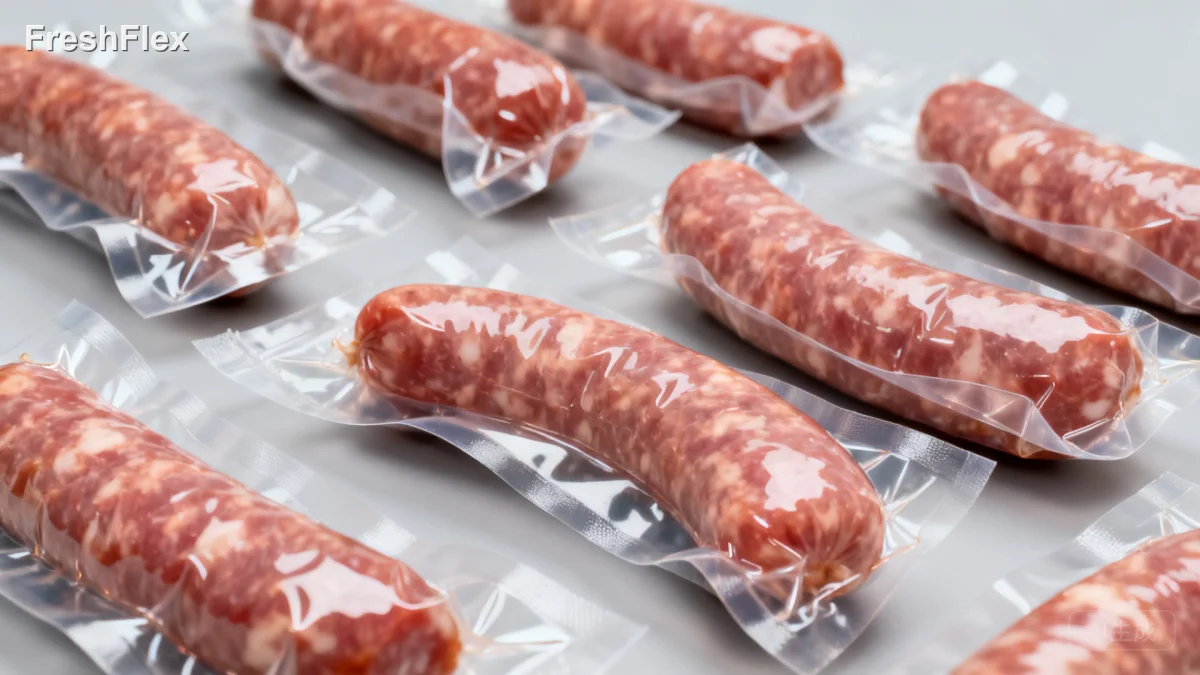
Fresh sausages require high moisture and oxygen barrier to prevent spoilage. Use PE/EVOH/PE or PA/EVOH/PE with moderate OTR. Vacuum packaging or modified atmosphere packaging (MAP) with high CO2 levels works well.
Cooked and Smoked Sausages
These are more stable but prone to color fade and rancidity. PP/EVOH/PP or PET/EVOH/PE films provide necessary barriers. For smoked varieties, ensure film does not absorb smoke volatiles.
Dry and Semi-Dry Sausages
Moisture loss is desired, but oxygen barrier is critical to prevent mold and rancidity. Use high-barrier EVOH films with controlled moisture vapor transmission rate (MVTR).
Retort Sausages
Require films that survive sterilization (121°C). PP/EVOH/PP structures are common. Ensure EVOH grade withstands thermal stress without delamination.
Cost-Benefit Analysis: EVOH vs. Alternatives
EVOH films cost more per kilogram than standard PE or PP. However, the total cost of ownership often favors EVOH when considering:
- Extended shelf life: Reduces returns and waste.
- Downgauging: Thinner EVOH layers can match barrier of thicker alternatives.
- Logistics savings: Longer shelf life may allow sea freight instead of air.
- Brand protection: Fewer quality complaints.
For example, a 70-micron PE/EVOH/PE film may cost 20–30% more than a 100-micron PA/PE film but offer 2–3 times the oxygen barrier, potentially doubling shelf life. Buyers should evaluate cost per packaged unit, not per kilogram.
Supplier Selection Checklist for Southeast Asia
When sourcing EVOH films in Vietnam, Indonesia, or Thailand, consider:
- Barrier certification: Request OTR and MVTR data at relevant temperature/humidity (e.g., 23°C, 50% RH and 38°C, 90% RH).
- Food contact compliance: Ensure FDA, EU, or local equivalent approvals.
- Coextrusion capability: Uniform EVOH distribution and tie-layer adhesion.
- Technical support: Assistance with structure design and machine trials.
- Supply reliability: Local stock or short lead times to avoid production delays.
- Customization: Ability to adjust thickness, width, and core size.
Conclusion
EVOH film offers a robust solution for sausage packaging, balancing barrier performance, processability, and cost. By understanding sausage types, film structures, and total cost factors, buyers in Southeast Asia can make informed decisions that protect product quality and brand reputation. FreshFlex specializes in high-barrier EVOH films tailored for regional needs—contact us to discuss your specific requirements.